As our district pivots to The Science of Reading, teaching phonics in Core French may sound like an obvious choice in teaching strategies. But until recently, this was not part of our curriculum. As you can imagine, this is no easy task but I am here to highlight what has worked and hasn’t worked in my Primary/Junior classes.
Teaching Grade 1-8, it’s easy to see the gaps in learning when it comes to Reading and writing in Core French. It is nearly impossible to ask students to sound out words they know, mostly due to the sheer volume of silent letters in French. It is also a task to ask students to read words out-loud that they have never used in class before.
Listen to Speak
This usually goes without saying but it is still such a powerful and eye-opening point of view; In order to have any hope of reading and writing, students need to have a large enough vocabulary to understand what they are reading.
In the first years of Core French, it is imperative that students receive as much basic vocabulary and sentence structure as possible. This can be done through stories, games, songs, videos, picture talks and Circle time.
Students will hear French being spoken, come to understand the meaning of these words, and slowly gain the confidence to repeat these phrases in appropriate ways.
Speak to Read
Once students are able to fluently converse and generate accurate sentences orally, it is time to start with Phonics education.
The joy of teaching Core French, is one can piggy-back off of the teachings in Language class. They are learning to blend and sound out in their native language. In Ontario schools that offer Core French in Grade 1-3, our curriculum is requiring Reading to be assessed by 1st term Grade 2. This leaves all of Grade 1 to instill a healthy amount of vocabulary and oral communication skills.
By September of Grade 2, students will have a significant base of phonics and writing conventions in English, that Core French instruction can transfer this knowledge to a new language. Learning the sounds of individual letters, blends, nasal sounds and sight words, will be the main focus of 1st term.
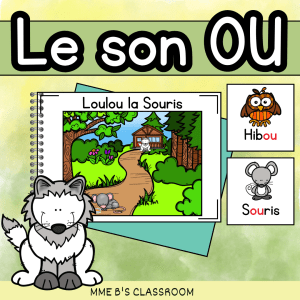
Obvious statement #2; students will not be able to read a word if they have never heard it spoken aloud before. They will use all of the Phonics knowledge to sound out and manipulate a word to read it, but if they have never heard it, or spoken that word before, it is time wasted. They will never be able to self-correct for rule-exceptions or place the word in context of the sentence. In order to properly decode a text, all words must be available in their “bank of knowledge”.
Teaching sounds and blends, then practicing with stories and phonic centers, is a great way to engrain this new information in a way that allows students to learn at their own pace. Since the curriculum is very open ended, teachers can plan to go as fast or as slow as the students need to master their skills.
Reading to Write
With so many silent letters in French writing, it would be nearly impossible for young students to remember all of the rules. Remember, these are not French Immersion students, spending 4 hours per day learning the language, with support systems as home. These students are learning 40 minutes per day, sometimes as their 3rd language, with zero supports.
Having the basics of Phonics in their tool-belt, students will truly be able to “sound it out”. Once they have read a specific word enough times, they will remember by sight when a silent letter needs to be added.
In terms of authentic sentence generation; if a student has spent the last 2 years orally communicating complete sentences, they will have no problems putting those thoughts to paper. Gone are the days of Grade 8 students writing “Je j’aime Mon le chat”, and welcome students in 2nd term Grade 2 writing “j’aime mon chat, Lucy. Elle est noir.”
Sentence generation will be limited to vocabulary and structure learned in class, but when we reevaluate the expectations of our students, as well as help them reevaluate what they are capable of, they will be one step closer to freeing themselves of the need to Google Translate everything.
Keep Core French Fun
The best way to kill a students love of learning, is to make it tedicous or pointless. Students now-a-days need an authentic, personalized reason to learn French or they will shut down.
Making Core French feel like a brain-break will have them asking “When is French?!” or shouting “YAY! It’s French time!” when you walk in the door. If a student tells me they love French class, regardless of how successful they are in the language, makes it all worth it.
Obvious statement #3; Just because a student is modified in Language, doesn’t always mean they need modification in French. Because we are learning French at such a slower pace, and the expectations are so much lower than Language, it is reasonable to see students struggle in Language yet excel in French class. If delivered properly, the fun and games of Core French will help boost their self-confidence and allow them to try without fear of failure or ridicule. Many times, students are their own worst enemy and this fear of failure prevents them of absorbing the information, or encourages them to refuse the work. Why would a student refuse to sing along with “Je suis un pizza”?
Reflection
I hope this helps planning next years’ Core French lessons. Be sure to follow along as I present more Phonics and Science of Reading tips, resources and more here on the blog and on TPT.


 Mme B's Classroom
Leave a comment